



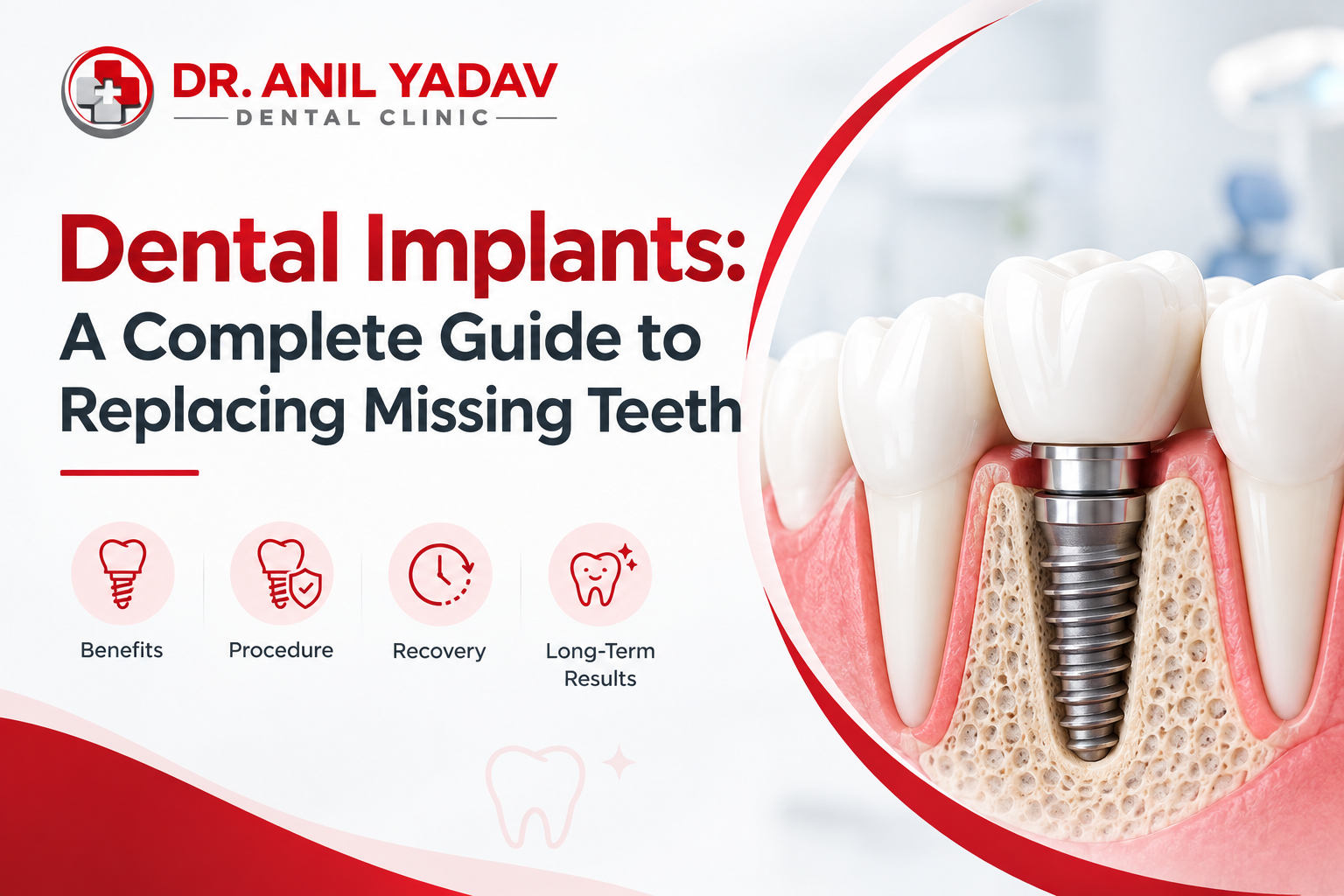
Losing a tooth can affect much more than your smile. Missing teeth can make chewing difficult, affect speech, change the appearance of your face, and may gradually affect the surrounding teeth and jawbone. Fortunately, modern dentistry offers a reliable solution for replacing missing teeth: dental implants.
Dental implants are designed to replace the root of a missing tooth and support a dental crown, bridge, or other restoration. When properly planned and maintained, implants can provide a stable, natural-looking, and functional replacement for missing teeth.
At Dr. Anil Yadav Dental Clinic in Gurgaon, dental implant treatment is planned according to each patient’s oral health, bone condition, aesthetic requirements, and overall treatment goals.
What Are Dental Implants?
A dental implant is a small post, commonly made from titanium or another biocompatible material, that is surgically placed into the jawbone. It functions as an artificial tooth root.
After the implant integrates with the surrounding bone, a customized dental restoration such as a crown is attached to restore the visible portion of the tooth.
A typical dental implant has three main components:
- Implant: The portion placed into the jawbone and used as an artificial tooth root.
- Abutment: A connector that joins the implant to the restoration.
- Dental Crown: The visible tooth-shaped restoration designed to restore appearance and function.
Dental implants can be used to replace a single missing tooth, multiple missing teeth, or support certain full-mouth rehabilitation solutions.
Why Are Dental Implants Needed?
A missing tooth leaves a gap that can affect your oral health over time. Depending on the location and number of missing teeth, you may experience:
- Difficulty chewing certain foods
- Changes in speech
- Movement or shifting of neighbouring teeth
- Reduced confidence while smiling
- Changes in bite
- Progressive loss of bone in the area of the missing tooth
Replacing the missing tooth can help restore oral function and improve the appearance of your smile.
Who Can Get Dental Implants?
Many adults with missing teeth may be candidates for dental implants. However, suitability depends on several factors, including:
- Overall oral health
- Condition and volume of the jawbone
- Gum health
- Number and location of missing teeth
- Oral hygiene
- Certain medical conditions and medications
- Smoking or tobacco use
A dental examination and appropriate imaging are necessary before treatment. At Dr. Anil Yadav Dental Clinic, advanced CBCT 3D imaging can be used to assess the jawbone and surrounding structures and assist with treatment planning.
If there is insufficient bone in the implant area, procedures such as bone grafting or sinus augmentation may sometimes be considered depending on the individual case.
What Is the Dental Implant Procedure?
Dental implant treatment is planned individually, so the exact number of appointments and treatment timeline can vary.
1. Initial Consultation
The dentist examines your teeth, gums, bite, and overall oral health. Your dental and medical history is also considered.
2. Digital Imaging and Treatment Planning
Imaging such as X-rays or CBCT scans may be used to evaluate the available bone and identify important anatomical structures.
At Dr. Anil Yadav Dental Clinic, CBCT provides detailed three-dimensional images that can support diagnosis and implant treatment planning.
3. Implant Placement
The implant is surgically placed into the jawbone at the planned location. Local anaesthesia is generally used during the procedure.
4. Healing and Osseointegration
The implant needs time to integrate with the surrounding bone. This process is called osseointegration. The duration varies depending on the individual patient and treatment.
5. Abutment and Crown Placement
Once the implant has adequately healed and is ready for restoration, an abutment and customized dental crown may be placed.
6. Follow-Up and Maintenance
Regular dental check-ups and good oral hygiene are important for maintaining the health of the implant and surrounding tissues.
What Are the Benefits of Dental Implants?
Dental implants can offer several advantages when they are appropriately planned and maintained.
Natural-Looking Appearance
A customized crown can be designed to match the colour, shape, and proportions of your surrounding teeth.
Improved Chewing Function
Implant-supported teeth are fixed in place, allowing you to chew more comfortably compared with some removable tooth-replacement options.
Stability
Unlike removable dentures, an individual implant-supported crown is anchored to the jawbone.
Support for Multiple Missing Teeth
Implants may be used individually or as part of implant-supported bridges and full-mouth rehabilitation, depending on the patient’s needs.
Helps Preserve the Jawbone
The presence of an implant in the jawbone can provide stimulation that is beneficial for maintaining bone in the area of the missing tooth.
Dental Implants vs. Dentures vs. Bridges
There are several ways to replace missing teeth, and there is no single option that is suitable for everyone.
Dental implants are anchored in the jawbone and can support individual crowns, bridges, or other restorations.
Dental bridges replace missing teeth by using neighbouring teeth or implants for support.
Dentures are removable appliances used to replace several or all missing teeth.
The appropriate treatment depends on factors such as the number of missing teeth, bone condition, gum health, budget, aesthetics, and personal preferences. Your dentist can explain the advantages and limitations of each option after examining your mouth.
Are Dental Implants Painful?
Dental implant placement is performed under anaesthesia, so patients generally should not feel pain during the surgical procedure.
Some soreness, swelling, or discomfort can occur after treatment. Your dentist will provide appropriate post-operative instructions and medications when required.
The experience can vary from patient to patient depending on the complexity of the procedure and individual healing.
How Long Do Dental Implants Last?
Dental implants are intended to be a long-term tooth-replacement solution. However, their longevity depends on several factors, including oral hygiene, gum health, bite forces, lifestyle habits, implant maintenance, and regular dental care.
Good brushing, cleaning between teeth, professional dental check-ups, and following your dentist’s instructions can help maintain the health of your implant and surrounding tissues.
Can Dental Implants Be Used for Multiple Missing Teeth?
Yes. Dental implants can be used in different treatment configurations depending on the number and location of missing teeth.
Possible solutions include:
- Single-tooth implants
- Implant-supported bridges
- Multiple dental implants
- Implant-supported dentures
- Full-mouth implant rehabilitation
Dr. Anil Yadav’s clinic provides implant treatments ranging from individual tooth replacement to more complex full-mouth implant solutions. Dr. Anil Yadav’s profile also lists experience with full-mouth implants, zygomatic implants, pterygoid implants, sinus lift procedures, and bone grafting.
Why Choose Dr. Anil Yadav Dental Clinic for Dental Implants in Gurgaon?
Choosing the right dental professional and treatment approach is an important part of successful implant care.
Dr. Anil Yadav is an Implantologist and Periodontist (MDS) with more than 25 years of clinical experience. According to the clinic’s profile, he has performed more than 10,000 dental implants and has experience with implant procedures ranging from routine cases to complex implant rehabilitation.
The clinic also uses modern dental technology, including CBCT 3D imaging and digital intraoral scanning. The clinic describes its intraoral scanner as providing digital accuracy and eliminating the need for conventional impressions in appropriate workflows.
Dental Implant Aftercare Tips
Taking care of your implant after treatment is essential.
- Brush your teeth twice a day.
- Clean carefully around the implant and gumline.
- Follow your dentist’s post-treatment instructions.
- Attend scheduled follow-up appointments.
- Avoid smoking and tobacco products.
- Do not use the implant to bite excessively hard objects.
- Inform your dentist if you notice persistent pain, swelling, bleeding, or mobility.