

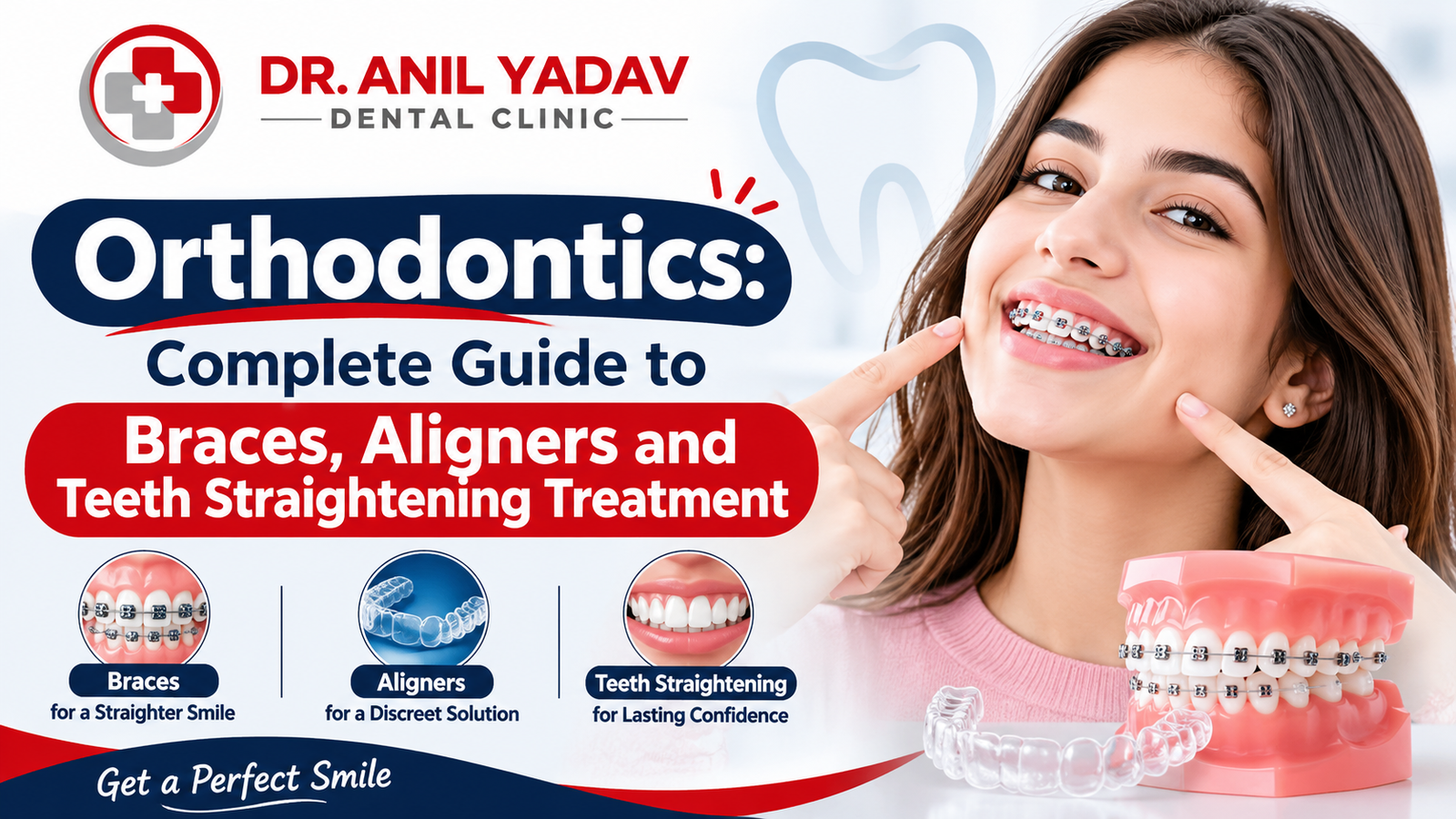
A beautiful smile is not just about appearance; properly aligned teeth also play an important role in maintaining good oral health. Crooked teeth, overcrowding, gaps between teeth, and bite problems can affect chewing, speech, oral hygiene, and overall confidence. Orthodontics is the specialised branch of dentistry that focuses on diagnosing, preventing, and correcting these dental alignment problems.
Whether you are looking for traditional metal braces, ceramic braces, invisible braces, or clear aligners, modern orthodontic treatments offer several options to help you achieve a healthier and more confident smile.
If you are searching for advanced orthodontic treatment in Gurgaon, Dr. Anil Yadav Dental Clinic provides specialised orthodontic solutions for children, teenagers, and adults. With specialist orthodontists, modern dental technology, and personalised treatment planning, the clinic focuses on correcting misaligned teeth and improving overall dental function.
What Is Orthodontics?
Orthodontics is a specialised field of dentistry that deals with the correction of improperly positioned teeth and jaws. It helps improve the alignment of teeth, correct bite-related problems, and enhance the overall appearance of a smile.
Orthodontic treatment uses dental appliances such as braces, clear aligners, and retainers to gradually move teeth into their desired positions.
The treatment is not limited to cosmetic improvements. Properly aligned teeth can also make brushing and flossing easier, improve chewing efficiency, and help maintain better oral hygiene.
Why Is Orthodontic Treatment Important?
Misaligned teeth and bite problems can create several challenges in everyday life. If left untreated, certain orthodontic conditions may contribute to dental complications.
Some important benefits of orthodontic treatment include:
- Improved Smile Appearance: Corrects crooked, crowded, and uneven teeth.
- Better Oral Hygiene: Properly aligned teeth are generally easier to brush and floss.
- Improved Chewing Function: Correcting bite problems can improve how the upper and lower teeth meet.
- Better Speech Function: Some dental alignment problems can contribute to speech difficulties.
- Reduced Uneven Tooth Wear: Correcting an abnormal bite can help distribute chewing forces more evenly.
- Improved Confidence: A well-aligned smile can positively influence personal confidence.
Orthodontic treatment is planned according to the patient’s dental condition, jaw development, and individual requirements.
Common Dental Problems That Require Orthodontic Treatment
Not every orthodontic patient has the same dental concern. Some people require treatment for crooked teeth, while others may need correction of more complex bite problems.
Here are some common conditions treated through orthodontics.
1. Crowded Teeth
Dental crowding occurs when there is insufficient space in the jaw for all teeth to fit properly. As a result, teeth may overlap, rotate, or become twisted.
Crowded teeth can make cleaning difficult and increase the risk of plaque accumulation and gum problems.
Orthodontic treatment helps create appropriate alignment and improve the positioning of teeth.
2. Gapped Teeth
Gapped teeth, also known as diastema, refer to visible spaces between two or more teeth.
These gaps may develop due to differences in tooth size, jaw size, missing teeth, or certain oral habits.
Braces or clear aligners may help close unwanted spaces depending on their cause and severity.
3. Overbite
An overbite occurs when the upper front teeth overlap the lower front teeth more than normal.
Depending on its severity, an excessive overbite may contribute to tooth wear, gum problems, and other bite-related concerns.
Orthodontic treatment can help improve the relationship between the upper and lower teeth.
4. Underbite
An underbite occurs when the lower front teeth extend beyond the upper front teeth when the mouth is closed.
It may be associated with differences in jaw growth or dental positioning.
Treatment depends on the patient’s age, jaw development, and severity of the condition. Some cases can be managed with orthodontics, while more complex skeletal cases may require combined orthodontic and surgical treatment.
5. Crossbite
A crossbite occurs when one or more upper teeth bite inside the lower teeth instead of outside them.
It may affect individual teeth or several teeth and can sometimes contribute to uneven tooth wear or jaw-related problems.
Early diagnosis is particularly useful in growing children.
6. Open Bite
An open bite occurs when the upper and lower front teeth do not meet when the back teeth are together.
It may be associated with tongue habits, thumb sucking, or jaw development patterns.
Orthodontic treatment can help correct selected open-bite conditions based on their underlying cause.
Types of Orthodontic Treatments Available
Modern orthodontics offers different treatment options depending on the patient’s age, dental alignment, lifestyle, and treatment goals.
At Dr. Anil Yadav Dental Clinic, patients can explore different orthodontic options with specialist orthodontists.
1. Metal Braces
Traditional metal braces are among the most commonly used orthodontic appliances for correcting misaligned teeth.
They consist of small metal brackets attached to the teeth and connected through an orthodontic wire. The wire applies controlled pressure to gradually move teeth into their desired positions.
Benefits of Metal Braces:
- Suitable for a wide range of orthodontic problems.
- Effective for correcting complex tooth movements.
- Fixed appliances that do not require daily removal.
- Generally more economical than many alternative orthodontic options.
Metal braces are commonly recommended for children, teenagers, and adults who need comprehensive teeth alignment.
2. Ceramic Braces
Ceramic braces work similarly to traditional metal braces but use tooth-coloured or translucent brackets.
They are designed to blend more naturally with the teeth, making them a popular option for patients who want a less noticeable orthodontic appliance.
Benefits of Ceramic Braces:
- Less noticeable than conventional metal braces.
- Effective for correcting many alignment problems.
- Suitable for patients concerned about the appearance of traditional braces.
However, ceramic brackets may require additional care to avoid staining and damage.
3. Invisible Braces
Invisible braces are designed for individuals who prefer a more discreet way to straighten their teeth.
Depending on the system used, this term may refer to clear aligners or less visible fixed orthodontic appliances.
They offer an aesthetic alternative to conventional metal braces for suitable orthodontic cases.
4. Clear Aligners
Clear aligners are transparent, removable trays designed to gradually move teeth into the correct positions.
Patients typically wear a series of customised aligners, with each set making small adjustments to tooth positioning.
Benefits of Clear Aligners:
- Transparent and discreet appearance.
- Removable during meals.
- Easier brushing and flossing compared with fixed braces.
- Comfortable design without conventional brackets and wires.
- Suitable for selected mild to complex orthodontic conditions.
Clear aligners generally need to be worn for approximately 20–22 hours daily, as directed by the orthodontist.
Patient cooperation is important for achieving the planned results.
5. Micro Braces
Micro braces are designed with smaller brackets than conventional braces.
They provide an alternative for patients who want fixed orthodontic treatment with a relatively compact appliance.
Their suitability depends on the patient’s tooth alignment and orthodontic requirements.
6. Retainers
Retainers are orthodontic appliances used after active teeth-straightening treatment.
Once braces or aligners have corrected the position of teeth, retainers help maintain the achieved alignment and reduce the risk of teeth shifting back.
Retainers may be removable or fixed, depending on the orthodontist’s recommendation.
Wearing retainers as instructed is an essential part of long-term orthodontic care.
Orthodontic Treatment for Children, Teenagers and Adults
One common misconception is that orthodontic treatment is only suitable for children and teenagers. In reality, healthy teeth can be moved at different stages of life.
Orthodontics for Children
Early orthodontic evaluation helps identify developing problems related to tooth alignment, jaw growth, and bite development.
An orthodontist can monitor dental development and determine whether early intervention is necessary.
Potential benefits include:
- Identifying developing bite problems.
- Monitoring jaw growth.
- Addressing certain harmful oral habits.
- Managing developing dental crowding.
- Guiding permanent teeth into better positions where appropriate.
An initial orthodontic evaluation is generally recommended around the age of seven, although not every child needs immediate treatment.
Orthodontics for Teenagers
The teenage years are a common time for orthodontic treatment because most permanent teeth have erupted and the jaws are still developing.
Treatment options may include metal braces, ceramic braces, and clear aligners, depending on individual suitability.
Orthodontics for Adults
Adults can also benefit from orthodontic treatment.
Many adults choose braces or clear aligners to correct long-standing alignment problems, close gaps, improve bite function, or prepare their teeth for other dental procedures.
Modern orthodontic options make it possible to achieve improved dental alignment without necessarily using traditional metal braces.
How Long Does Orthodontic Treatment Take?
The duration of orthodontic treatment varies depending on the complexity of the dental problem, the treatment method, and patient cooperation.
Typical treatment timelines may include:
| Treatment complexity | Approximate duration |
|---|---|
| Minor alignment problems | 6–12 months |
| Moderate alignment problems | 12–18 months |
| Complex orthodontic cases | 18–30 months or longer |
These are general estimates, not guaranteed timelines. Your orthodontist will provide a more accurate treatment estimate after examining your teeth and jaws.
Regular follow-up appointments and following treatment instructions can help keep orthodontic treatment on track.
What Is the Difference Between Braces and Clear Aligners?
Both braces and clear aligners help correct teeth alignment, but they work differently.
| Feature | Traditional Braces | Clear Aligners |
|---|---|---|
| Appearance | Visible brackets and wires | Transparent trays |
| Removability | Fixed | Removable |
| Eating | Some food restrictions | Removed during meals |
| Oral hygiene | Requires extra cleaning | Easier to brush and floss |
| Patient cooperation | Less dependent on daily wear decisions | Requires consistent wear |
| Treatment suitability | Wide range of cases | Suitable for selected cases |
The best treatment option depends on your dental condition, bite, lifestyle, and orthodontist’s assessment.
What Happens During an Orthodontic Consultation?
If you are planning to undergo orthodontic treatment, the first step is a detailed consultation with an orthodontist.
At Dr. Anil Yadav Dental Clinic, the treatment journey follows a personalised approach.
Step 1: Initial Dental Examination
The orthodontist examines your teeth, gums, jaw alignment, and bite to understand your dental concerns.
Step 2: Diagnostic Assessment
Depending on the case, dental X-rays, OPG, CBCT imaging, photographs, and digital scans may be recommended.
Step 3: Treatment Planning
The orthodontist evaluates the available treatment options and explains the expected treatment duration, procedure, and aftercare requirements.
Step 4: Starting Orthodontic Treatment
Once the treatment plan is finalised, braces or aligners are provided according to the selected approach.
Step 5: Regular Follow-up Appointments
Periodic visits help monitor tooth movement and make necessary adjustments.
Step 6: Retention Phase
After the active treatment is completed, retainers help maintain the corrected tooth positions.
Why Choose Dr. Anil Yadav Dental Clinic for Orthodontic Treatment?
Choosing the right dental clinic is important for achieving successful orthodontic outcomes. Orthodontic treatment requires proper diagnosis, careful planning, regular monitoring, and long-term follow-up.
Dr. Anil Yadav Dental Clinic offers specialised orthodontic services for patients looking to improve their dental alignment and smile.
Key highlights include:
- Specialist orthodontists offering different teeth-straightening solutions.
- Options including metal, ceramic, invisible braces, micro braces, and aligners.
- Orthodontic treatment for children, teenagers, and adults.
- Modern diagnostic facilities.
- Digital Cone Beam Computed Tomography (CBCT) for detailed three-dimensional imaging when indicated.
- 3Shape TRIOS intraoral scanning technology for accurate digital impressions.
- Personalised orthodontic treatment planning.
- Comprehensive dental services under one roof.
- Focus on patient comfort, hygiene, and treatment quality.
The clinic combines professional dental care with modern diagnostic technology to support accurate treatment assessment and planning.
Tips to Maintain Oral Hygiene During Orthodontic Treatment
Maintaining oral hygiene becomes particularly important when wearing braces or other orthodontic appliances.
Food particles and plaque can accumulate around brackets, wires, and between teeth, increasing the risk of cavities and gum inflammation.
Follow these tips:
- Brush your teeth carefully at least twice daily.
- Use an orthodontic toothbrush or suitable cleaning aids.
- Clean around brackets and wires properly.
- Use interdental brushes to remove food particles.
- Floss regularly with suitable flossing tools.
- Limit sticky, hard, and excessively sugary foods when wearing braces.
- Avoid biting directly into hard foods that may damage brackets.
- Attend scheduled orthodontic appointments.
- Wear clear aligners and retainers as instructed.
- Contact your orthodontist if a bracket or wire becomes loose or causes discomfort.
Good oral hygiene throughout treatment helps protect your teeth and gums.
Book Your Orthodontic Consultation at Dr. Anil Yadav Dental Clinic
A properly aligned smile can make a difference to your oral health, chewing function, and confidence.
Whether you are dealing with crooked teeth, gaps, crowded teeth, overbite, underbite, or other alignment problems, orthodontic treatment can help improve your dental condition.
At Dr. Anil Yadav Dental Clinic, Gurgaon, patients can explore different orthodontic solutions, including metal braces, ceramic braces, invisible braces, micro braces, clear aligners, and retainers.
The specialist orthodontists assess each patient’s dental condition and recommend suitable treatment options based on individual needs.
If you are considering braces or clear aligners, schedule an orthodontic consultation to understand which treatment is right for your smile.
Book Your Appointment Today!
Clinic Name: Dr. Anil Yadav Dental Clinic
Address: Arogyam Building, New Railway Road, Near Sheetla Hospital, Subhash Nagar, Manohar Nagar, Sector 8, Gurugram, Haryana – 122001.
Contact Number: +91 92123 45041
Website: https://dranilyadavdentalclinic.com/
Frequently Asked Questions (FAQs)
1. What is orthodontic treatment?
Orthodontic treatment is a specialised dental procedure used to correct crooked teeth, crowded teeth, gaps, and bite-related problems. It uses braces, clear aligners, and other orthodontic appliances to improve tooth alignment.
2. What is the best age to start orthodontic treatment?
An initial orthodontic evaluation is generally recommended around seven years of age. However, the appropriate treatment time depends on dental development and the nature of the problem. Adults can also undergo orthodontic treatment.
3. Are braces better than clear aligners?
Both braces and clear aligners can effectively correct teeth alignment in suitable cases. Braces are useful for a wide range of complex tooth movements, while clear aligners offer a removable and less noticeable alternative. An orthodontist can recommend the best option after examination.
4. How long does orthodontic treatment take?
Orthodontic treatment usually takes between 6 and 30 months or longer, depending on the complexity of the case, treatment method, and patient cooperation.
5. Can adults undergo orthodontic treatment?
Yes. Adults with healthy teeth and gums can undergo orthodontic treatment. Metal braces, ceramic braces, and clear aligners may be considered depending on their dental condition.
6. Do braces cause pain?
Patients may experience temporary pressure, tenderness, or mild discomfort after braces are initially fitted or adjusted. This generally improves as the mouth adapts to the appliance.
7. What happens if I do not wear my retainer after braces?
Teeth can gradually shift towards their previous positions after orthodontic treatment. Wearing retainers as recommended by your orthodontist helps maintain the corrected alignment.
8. Are invisible braces suitable for everyone?
No. Invisible braces and clear aligners are suitable for many alignment problems, but not every orthodontic condition can be treated with them. A clinical examination is necessary to determine suitability.
9. How much does orthodontic treatment cost in Gurgaon?
The cost depends on the type of braces or aligners, complexity of the dental condition, treatment duration, and follow-up requirements. Contact Dr. Anil Yadav Dental Clinic for a personalised consultation and cost estimate.
10. Where can I get orthodontic treatment in Gurgaon?
You can consult the specialist orthodontists at Dr. Anil Yadav Dental Clinic, located at Arogyam Building, New Railway Road, near Sheetla Hospital, Gurugram, Haryana – 122001.